
For robot model developers
Robot robustness testing under changing conditions
Which changes to a task expose the limits of your model?
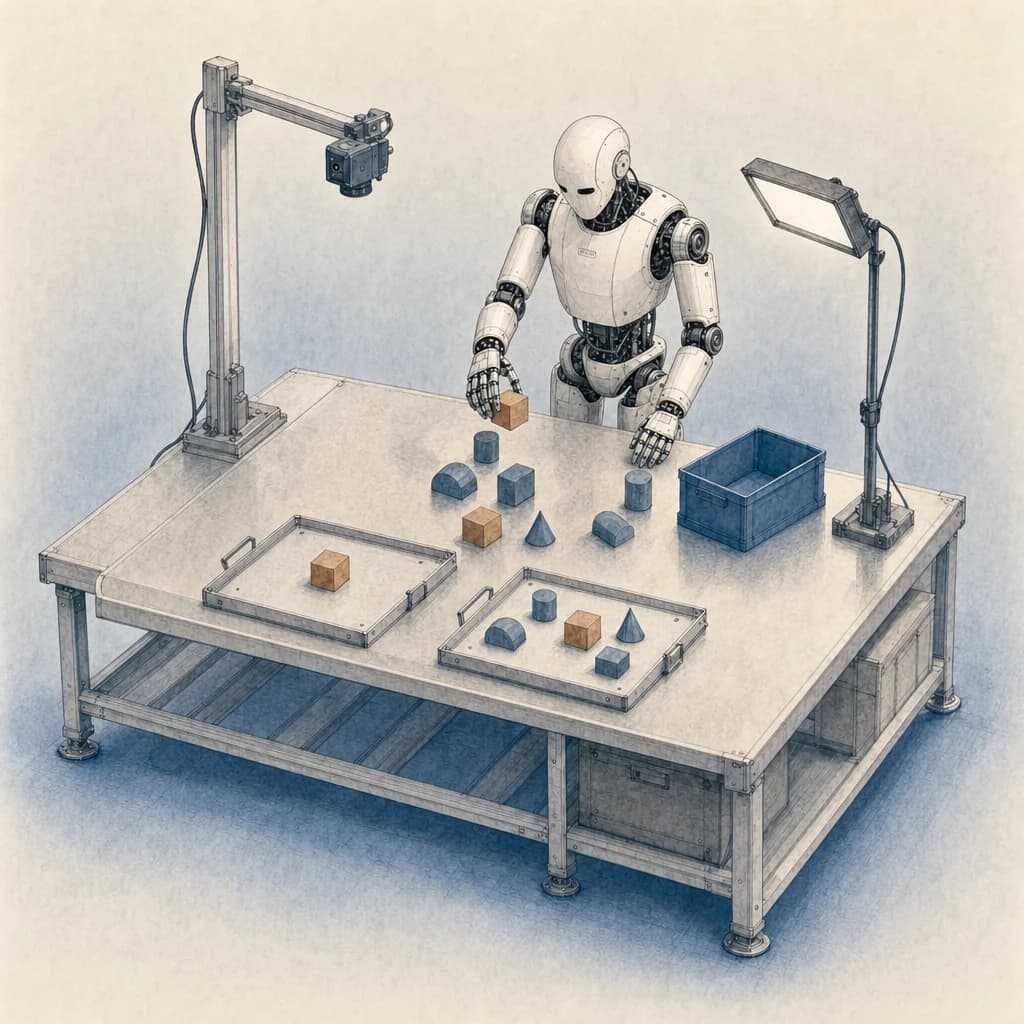
Choose variations from the workflow
A policy that succeeds in one carefully arranged scene may behave differently when an object moves or the workspace becomes cluttered. A useful robustness test starts by identifying which variations are common or consequential in the intended workflow.
Coop works with model developers to turn those questions into a bounded test matrix. Candidate factors include object placement, lighting, distractors, and starting arrangements. The protocol records the range of each variation and the reason it belongs in the evaluation.
Make the changed condition explicit
A reference condition gives each variation a point of comparison. We specify which factors change and which remain fixed, and use repeated trials to separate recurring behavior from a single failed attempt.
Changing one factor at a time can make a failure easier to interpret, but it does not test interactions between factors. If combinations matter to the workflow, they need their own planned conditions. Held-out objects or arrangements must remain separate from the model’s adaptation and tuning cases.
Map the limits, including uncertainty
Results are broken down by condition, with autonomous completion, intervention counts, and representative failures linked to the trial ledger. This helps a developer decide what to improve and which conditions warrant another study.
A robustness result is local to the variations that were tested. It does not establish performance under arbitrary environmental changes, on a different embodiment, or throughout an entire industry. Hardware and integration problems are distinguished from policy behavior when the evidence permits.
- A documented reference condition and variation ranges.
- A fixed success rule and assistance policy.
- Repeated trials across the planned conditions.
- Explicit separation of observed failure from suspected cause.
Questions about robustness testing
Is robustness the same as generalization?
A robustness test measures response to defined changes. A generalization claim also needs an account of what was held out from training or adaptation. The report should make both the tested changes and the preparation history explicit.
Can we compare robustness across models?
Yes, when the models run on a common setup and share the same variation matrix and scoring rules. Otherwise hardware and protocol differences can be mixed into the apparent model difference.
Can a lab test prove deployment readiness?
It can provide evidence about a specific task and configuration. Deployment introduces additional operating requirements and conditions that need their own validation.
Further reading
From an industry workflow to a repeatable robot benchmark